Showing posts with label Iranian. Show all posts

Monday, 30 April 2012

Iranian Recipes

This month on Gormandize with A-dizzle and K-bobo I've been experimenting with recreating some delicious and classic Iranian dishes in a vegan friendly manner. It's been such a delicious month and I have to give a huge thank you to the person who requested that I feature Iran - what a great choice!! But now it has come to an end - so here is a recap of the tasty treats featured. I hope you enjoyed the learning journey with me. If you'd like to get in on it and request a country for me to feature then head over to this post. Here is what we ate over the last month:


~Savoury~

Artichoke and Pine Nut Dolma
I've never liked dolma very much at all, so this month I was able to do something I've always wanted to - make my own fresh ones with a filling that I knew I would love. These were filled with artichoke hearts, tomato, dill and toasted pine nuts and cooked fresh right before eating! They were sensational! Check out the recipe here.

Salad-e Shirazi
This is a light and tangy classic salad. Tomato, onion, cucumber, fresh herbs and lots of lime juice. It's not a challenging or unusual salad but it's a classic that is simple to make and you can eat it every day. Check out the recipe here.

Naaz Khatoon
This eggplant and tomato dish was delicatedly flavoured with verjuice and pomegranate molasses - classic ingredients in Iranian cooking. I had a fun time heading out to find some pomegranate molasses, and it was worth the hunt! Check out the recipe here.

~Sweet~

Yakh Dar Behesht
This delight was called Ice in Heaven - although I don't know why because it's not frozen! But that aside, this was something pretty special. Essentially it only has six ingredients in it and only takes about 10 minutes of cooking time. It's a very special treat to serve up to guests, and a very healthy dessert option. I made mine vegan by using delicious almond milk. Check out the recipe here.

Sholeh Zard
I love rice pudding in any form. This Persian one was flavoured with rosewater (of course!) and had crunchy almonds and pistachios through it. Can be served hot or cold but I much preferred it hot! This post also contains my "student's saffron" - i.e. for people too poor to afford saffron! Check out the recipe here.

~Accompaniments~

Carrot and Rose Jam
I never knew until now that carrot makes such delicious jam! This is so easy to make and it just excites all your senses! The aroma is sweet rosewater, the colour is exceptionally orange and the taste is a pleasant surprise - sweet and tangy jam which doesn't leave that sickly taste in your mouth. Check out the recipe here.

Sugar Pickled Garlic
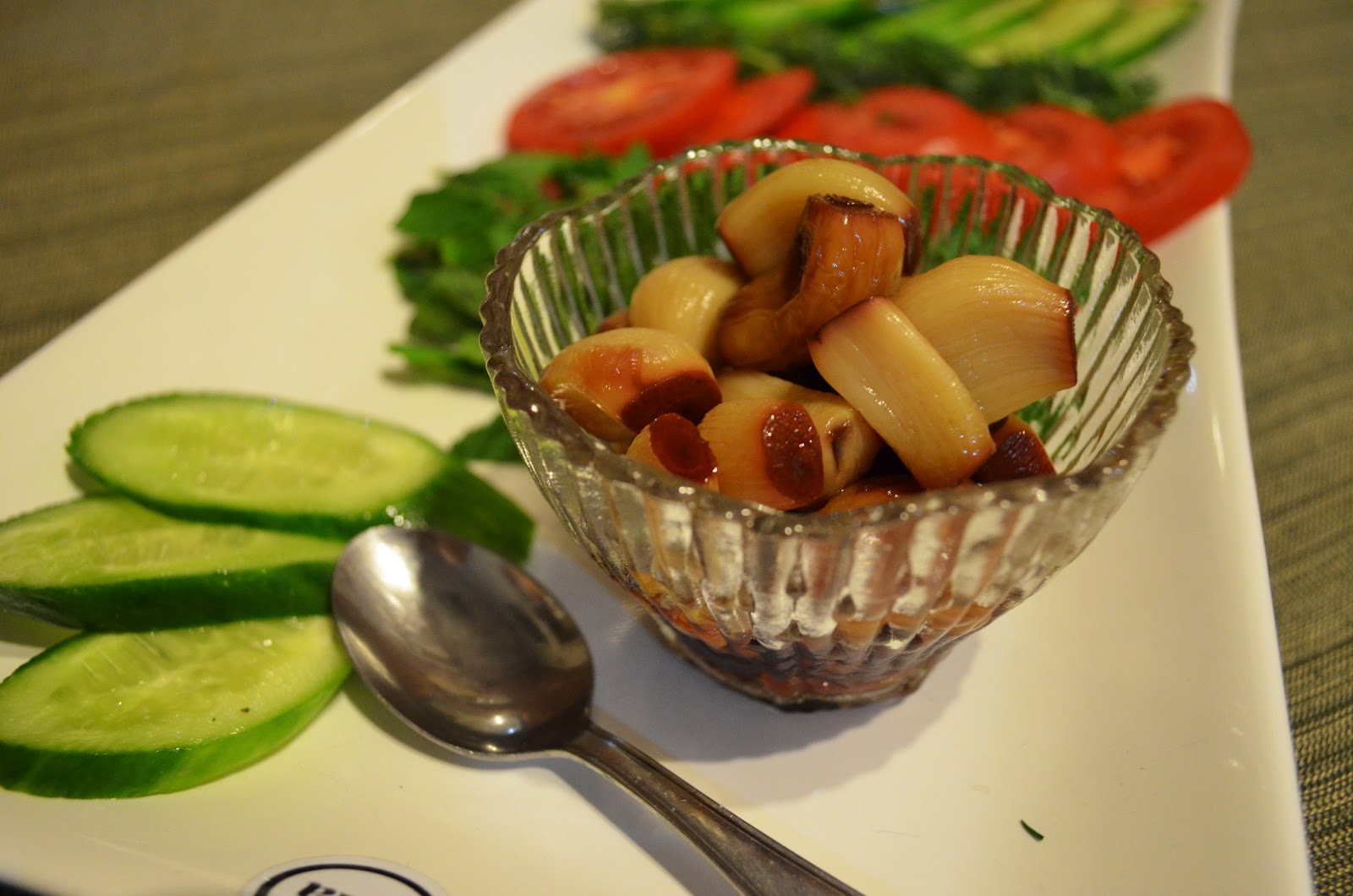
This was the surprise hit of the month. This sugar pickled garlic was delicious and was a huge hit with all my dinner guests, they absolutely loved it! Check out the recipe here.

Torshi-havij
The second pickled vegetables I made for this month - making my own pickles was such a bonus of doing Iran this month, as it's something I've never even thought about doing. These pickled carrots were also a big hit with one of my guests commenting it was like eating a "carbonated carrot" because of the tingly sensation in her mouth! Check out the recipe here. 

Mokhalafat
This one isn't as much as recipe as it is an information post. I loved the fact that traditional Iranian tables serve  a smorgasbord of tasty accompaniments to the meal so that guests can help themselves to whichever flavours they want more of - here is a post on what I served up for my guests as mokhalafat and what you could also include. Check it out here. 


I'm also very excited to announce that starting next month I'll be featuring wonderful and veganised versions of dishes from....

Scotland!


Want a sneak peak? Here it is...


I hope to see you next month for a highland feast!


On another note - I've been nominated for the Best Australian Blogs 2012 People's Choice Award - you can vote for me by hitting up this link: http://www.sydneywriterscentre.com.au/bloggingcomp/peopleschoice.html


Friday, 27 April 2012

Mokhalafat (Traditional Iranian Accompaniments)


Persian cuisine is one of the most ancient and developed styles of cooking in the world. I love exploring the dishes of countries which have a rich food culture and history and Iran is certainly one of them. This is my last recipe for Iran month (how I have loved it!), and to be honest, it's not really a recipe. It's something I wanted to share and discuss. When researching Iranian cuisine and recipes I found references to Mokhalafat - the traditional accompaniments which should be served with each meal. I loved the idea so when I had my friends around to help me eat all the Iranian food I had cooked I was sure to provide a big plate of mokhalafat with it! 

Mokhalafat varies between regions and probably between families but here are some core ingredients: fresh herbs, pickled vegetables, fresh tomato and cucumber and flat bread. I didn't add flat bread to mine because I was already serving my guests a wealth of food so I didn't want them to fill up on bread! Here is what I used in my mokhalafat:

Ingredients
1/2 bunch fresh mint (chopped)
1/2 bunch fresh dill (chopped)
1/2 bunch fresh parsley (chopped)
2 tomatoes, sliced
2 cucumbers, sliced
Gherkins or pickled cucumbers

You don't really need instructions for this one - just serve along with your main dishes as accompaniments. I arranged all of mine on one big plate but you could also serve in small separate bowls which can be passed around. As you will see I made my own pickles for this - so check out my recipes by clicking on the link.

Here are some other thing you can add to your mokhalafat (I would have loved to have been able to include it all!):

Fresh herbs - basil, corriander (cilantro), fenugreek, savory, tarragon, watercress
Flatbreads - such as lavash or barbari
White cheeses (if you're not a vegan)
Yoghourt (ditto)
Sliced raw onions
Wedges of lemon
Walnuts 
Dates
Other pickles (such as pickled cauliflower, turnip, radish or eggplant)
Fresh radishes


If you come from a Persian background or have experienced a traditional Persian meal I'd love to know what was served up as mokhalafat!


On another note - I've been nominated for the Best Australian Blogs 2012 People's Choice Award - you can vote for me by hitting up this link: http://www.sydneywriterscentre.com.au/bloggingcomp/peopleschoice.html


This month I'm featuring lots of amazing Iranian recipes!
Check out my other Iranian recipe posts:

Tuesday, 24 April 2012

Torshi-havij (Persian Pickled Carrots)


If you read this blog much then you'll have read how excited I was when I made home made Sugar-Pickled Garlic as part of Iran month. Well - good news! The excitement doesn't stop there because I also made some other pickles! Iranian and other Middle Eastern cuisines love their pickles. I remember the first time I went to a proper Lebanese restaurant and they brought out bread, hummous, baba ghanoush and garlic dip as soon as we sat down. Then they brought out this strange small dish of brightly coloured "things". I had no idea what they were until my Lebanese companions told me they were pickled turnips, radishes and cucumbers.

Like Lebanese cuisine, Iranian cuisine includes a plethora of different pickled vegetables - pickled cucumbers, pickled cauliflower, pickled eggplant, pickled garlic, pickled onions and pickled carrots (read that list aloud really quickly and the word 'pickled' starts to sound really strange!). Although I was tempted to try all these I limited myself to two - pickled garlic and pickled carrots. Both of which I served up to my guests at my Iranian feast as part of the mokhalafat (accompaniments).


These pickled carrots (torshi-havajii) went down really well with my guests (not to mention the fact that they were amazed that I made my own pickles!) and the word that was being bandied about the table as they ate them was "zingy". That describes them pretty well! One of my guests even said it felt like a carbonated drink in her mouth. They're quite strong so I recommend serving them as a side dish with a meal  - but be warned, they will made your meal incredibly special and very zingy :)

Ingredients
1 bunch baby carrots, trimmed and washed (about 100g)
5 cloves fresh garlic, peeled
1/2 tsp dried mint
15-20 black peppercorns
1/2 tsp salt
White wine vinegar (quantity will vary depending on the size of the jar you use)

To Make
1. Wash the carrots well (there is no need to peel them, but you can if you want to) and boil for about 3 minutes in boiling water. Remove from the water and allow to cool.
2. Once the carrots are cooled, place them in a jar with a good lid or seal. As you can see from my pics I used a wide preserving jar for mine, but I think it would be better to use a tall and thin jar so that you can stand the carrots up in it without needing to use so much vinegar.
3. Grate the garlic coarsely and add to the carrots in the jar. Add all other ingredients (except the vinegar).
4. Add enough white wine vinegar to the jar to cover the carrots completely. Put the lid on and store in the fridge for at least 3 weeks.

Makes 1 jar.


Sunday, 22 April 2012

Naaz Khatoon (Iranian Eggplant with Pomegranate Molasses)


This month is Iranian Food Month on Gormandize with A-dizzle and K-bobo and even though the month is nearing an end, I still have a few wonderful recipes to share before the time is up! This is one of them - delicious, easy and very easy to eat your way through a whole pot of it!

Eggplant forms a key part of Middle Eastern cuisine, from Baba Ghanoush to Khoresh Bademjan. In this Naaz Khatoon it is roasted, peeled and then cooked with tomatoes, verjuice and pomegranate molasses - all classic Iranian ingredients. I had to make a special excursion to buy myself the pomegranate molasses, as I've never used it before! Luckily, a lovely friend of mine is Lebanese and took me shopping with her to areas which I haven't been to that are a haven for buying Middle Eastern groceries! I had such a fun time and only my budget stopped me from buying a bit of everything that looked delicious :)

On another note - I've been nominated for the Best Australian Blogs 2012 People's Choice Award - you can vote for me by hitting up this link: http://www.sydneywriterscentre.com.au/bloggingcomp/peopleschoice.html

Naaz Khatoon
Adapted from the Iran Chamber Society website.


Ingredients
4 medium eggplants
4 large tomatoes
1/4 cup pomegranate molasses
1 tsp dried marjoram
1 tsp dried mint
1/2 tsp salt
1/2 cup verjuice

To Make
1. Wash eggplant and dry thoroughly. Bake in a moderate oven for about 30 minutes. Remove and let cool.
2. Peel the skins off (they should come away easily now) and dice the eggplant flesh (should be nice and juice after the baking so try and keep all the juices in by peeling them over the saucepan you're going to use).
3. Finely dice the onions and tomato.
4. Put all the ingredients except the verjuice in a large saucepan and put over a low heat. Cover and simmer over a low heat for 10 minutes. Remove from the heat and stir the verjuice through. Serve immediately.

You can eat as it is or serve with rice, pasta or bread.

Serves 4.


Friday, 20 April 2012

Salad-e Shirazi


It's classic of Middle Eastern feasts to have a beautiful fresh tomato and  herb salad and Iran is no exception. Iranian food is generally packed full of chopped herbs (sabzi) which make for incredible fresh and tangy salads. This recipe isn't the most unusual or remarkable salad you've ever come across, but it's one that you'll go back to and make again and again and again!

On another note - I've been nominated for the Best Australian Blogs 2012 People's Choice Award - you can vote for me by hitting up this link: http://www.sydneywriterscentre.com.au/bloggingcomp/peopleschoice.html

Ingredients
4 tomatoes
1 small onion
2 Lebanese cucumbers
Juice of 2 limes
1/2 bunch fresh mint
1/2 bunch fresh parsley
2 tbsp olive oil
1 tsp cracked black pepper
Salt to taste

To Make
1. Finely dice the tomatoes and then put in a strainer to strain out some of the juice while you prepare the rest of the ingredients (seems a shame to waste I know, but if you don't your salad will be very mushy!).
2. Peel the onion and dice very finely. Dice the cucumber.
3. Finely chop all the herbs.
4. Mix all the ingredients together in a bowl and allow to sit for about 20 minutes in the fridge. Serve.

Serves 2 (or 4 as a side salad).


Thursday, 19 April 2012

Sholeh Zard (Iranian Rice & Rosewater Pudding)


This is my latest offering in April - in which, I am featuring recipes from the amazing cuisine of Iran (check out the other recipes in the links below). Rice pudding is one of my favourite desserts, it's hearty, filling and warming for a cooler evening (and the evening have started to get a lot cooler here over the past week!). When I was young I didn't like rice pudding at all, but I think that I would have liked this deliciously simple sweet rosewater pudding. Sholeh Zard is a traditional Iranian dessert flavoured with rosewater and coloured with saffron. Traditionally it is served cold, however, I much preferred mine hot and would recommend it that way.

Talking Saffron....
Now comes the confession... I'm not exactly flush with money at the moment so I had to substitute my saffron! I know, true foodies would be horrified, but real saffron just wasn't an option for me! I'm also very conscious never to buy cheap saffron because it is usually fake, and some types of fake saffron are actually made from gelatine and food colouring (which horrified me when I found out!), therefore wouldn't be suitable for vegetarians or vegans (or anybody who doesn't consume animal products for religious or cultural reasons). I know that using turmeric instead of saffron is considered a culinary sin by high brow foodies, but sometimes needs must. However, I don't use just turmeric because it will go the wrong colour, so I add a pinch of sweet paprika as well to get a slightly more orangey hue. The recipe below includes options for saffron and for "student's saffron".

On another note - I've been nominated for the Best Australian Blogs 2012 People's Choice Award - you can vote for me by hitting up this link: http://www.sydneywriterscentre.com.au/bloggingcomp/peopleschoice.html

Ingredients
250g long grain or basmati rice
1.5L cold water
400g sugar
1/2 tsp real saffron (OR 1 tsp tumeric plus a pinch of sweet paprika)
1/2 cup hot water
1/2 cup rosewater
1/2 cup slivered almonds (plus extra for garnish)
1/2 cup pistachios

To Make
1. Prehead your oven to 150 degrees C. Place the rice in a strainer and rinse under cold running water until the water runs clear.
2. Place the rice and the water in a big saucepan and put over a medium heat. Simmer, uncovered, for about 15 minutes (or until the rice is just cooked). 
3. Add the sugar and stir well to dissolve. Transfer to a large baking dish (one that has a lid because you will need to cover it!).
4. Steep the saffron (or tumeric/paprika) in half a cup of hot water. Add the saffron, rosewater and almonds (except those which you will use to garnish). Stir well and cover.
5. Bake in the oven for half an hour. Let stand a bit to cool down before serving as it will be very hot coming out of the oven!
6. Roughly chop the pistachios (or pulse in a food processor). Garnish each serving liberally with slivered almonds and chopped pistachios before eating.

Serves 6.

Thursday, 12 April 2012

Iranian Sugar-Pickled Garlic


At the end of last month, when I announced that I would be featuring Iranian recipes all this month in this post, I hinted that you might be seeing something very garlicy from me - well here it is! Sugar pickled whole garlic cloves. You might be thinking that this just sounds a bit too overpowering and strong, but you'll just have to trust me (and all my dinner guests who loved this) when I tell you that it was amazing!

As a cook, I constantly reach little milestones of the development of my skills (I'm sure other cooks are alike),  these are mostly about doing things for the first time by hand (instead of buying things in jars, tins and packets from the supermarket). Things like making my own jam, making my own home made pasta (and then home made ravioli!), making my own pesto varieties or making my own infused spirits! All of these have been small milestones in my development as a cook and here is another one: making my own pickled vegetables!


This Iranian pickled garlic recipe was a great introduction, as it was very easy and didn't need to be stored for a long amount of time (as the garlic was cooked). This allowed me to prepare it in time to post as part of this month's Iranian recipes.


I served this pickled garlic and my torshi-havaj (recipe to come later!) to my dinner guests as part of mokhalafat (traditional Iranian table accompaniments) and it went down so well with my guests that some of them went so far as to say that it was their favourite dish of the night!

What is your favourite pickled vegetable?


Sugar Pickled Garlic
Adapted from www.food.com

Ingredients
3 whole heads of garlic
1/2 cup sugar
1 cup red wine vinegar
1 cup water
8 whole cloves
20 black peppercorns
1/2 tsp salt

To Make
1. Peel all the garlic cloves (I know! This is a pain but worth it!).
2. Place peeled garlic cloves with all other ingredients in a small saucepan. Place over a medium heat.
3. Bring to a boil and simmer, covered, for 10 minutes.
4. Remove lid and simmer for a further 5 minutes. Remove from heat and allow to cool.
5. Transfer to a glass jar with a tight lid and store in the fridge for at least 3 weeks before serving (1-2 months optimum).

Serve as an accompaniment, add to wraps and salads, add to a cheese platter or antipasto platter.


Tuesday, 10 April 2012

Vegan Yakh Dar Behesht (Ice in Heaven)


This Iranian sweet is quite unusual but also quite absurdly simple really. I'm not entirely sure why it's called Ice in Heaven - when I first read the name I thought it must be a milky frozen sweet, but then when I went to make it I find that it isn't frozen at all - it's just set with cornstarch just like Turkish Delight. It was delightfully simple to make and had a milky sweet taste with a lovely creamy consistency and colourful crunchy pistachios all over the top - what more could you ask for in a dessert?

The only thing you really need to know about it is that you have to stir it constantly to stop it going lumpy. I have to confess that I dropped the ball for a moment and ended up with some big sticky bits in mine but I managed to save it by putting the electric beaters through it on the highest setting and it whisked out the lumps. But learn from my mistake and just stir it continuously while you have it on the stove!


Yakh Dar Behesht
Adapted from the Iran Chamber Society website

Ingredients
1 litre almond milk
1 litre cold water
150g cornstarch
80g rice flour
500g raw sugar
1/2 cup rosewater
1 cup pistachios, very finely chopped

To Make
1. Place cold water in a large bowl and add the cornstarch. Stir well until the cornstarch is completely dissolved (there should be no lumps as long as you do this in cold water).
2. Place the almond milk and rice flour in a saucepan and stir well to dissolve. Add the cornstarch and place the saucepan over a low heat.
3. Stir continuously while the liquid heats up and bring it to a simmer. Stir continuously!!
4. Simmer for about 10 minutes or until it becomes the consistency of thick custard (stirring continuously!).
5. Pour into a large wide rectangular dish (like a big lasagne dish) and smooth the surface out level. Allow to cool.
6. Refrigerate for a couple of hours and then cut into diamond shaped slices in the pan.
7. Spread the crushed pistachios over the top and serve.

Serves 10-12.

Sunday, 8 April 2012

Artichoke & Pine Nut Dolma


Most of us encounter these little delights in the form of their Greek cousin, Dolmades. However, these parcels of rice wrapped in vine leaves also appear in Iranian cuisine (and some other Middle Eastern cuisines) called  Dolma. The term Dolma simply refers to something which is stuffed - in this case it refers to stuffed vine leaves. Eggplant, tomatoes, potatoes and many other vegetables can also be made into Dolma, simply by stuffing with a rice filling.

I've never been very fond of dolmades when I have had them from delicatessens or bought in restaurants or supermarkets. So, I have always thought that one day I would make my own and fill them with flavours that I love in the hope that I would finally enjoy them! I certainly did - having freshly made ones made such an amazing difference and I could happily eat these in vast quantities!


Ingredients
Preserved vine leaves (available from Middle Eastern grocers in packets or jars)
1 cup long grain rice
1/2 cup marinated artichoke hearts
1 large tomato
1/3 cup pine nuts
1/2 bunch dill
2 cups vegetable stock
2 tbsp olive oil
Juice of 1 lemon

To Make
1. Rinse the rice in cold water until the water runs clear. Place in a saucepan and cover with water. Bring to a boil and then reduce to a simmer. Simmer for 10 minutes and then drain and rinse immediately with cold water.
2. Place the rice in a large mixing bowl and spread it out to allow it to dry while you prepare the rest of the filling.
3. Score the tomato with a cross on the underside and place it in a bowl of boiling hot water for about 2 minutes, or until the skin is split and wrinkled. Remove and rinse under cold water. Peel the skin off and discard.
4. Dry fry the pine nuts in a saucepan to toast for 2-3 minutes, stirring frequently and watching carefully to make sure they don't burn.
5. Finely chop the artichoke hearts, peeled tomato and dill. 
6. Mix the rice, tomato, pine nuts, artichoke hearts and dill together. Season to taste with salt and pepper (optional).
7. Spread out a vine leaf (set aside any that have tears or holes and trim any long stems) and place a heaped tablespoon of rice filling at the base (at the point where the stem would have attached). Fold the two sides inwards and roll the leaf up tightly like a small cigar (because we've all done that before right??).
8. Line a wide pan with some of the ripped/discarded vine leaves and place the rolled vine leaves on them as you go, packing them in tightly so that they won't move around or unroll. 


9. Continue rolling until all the mix is used up. You will find that your dolma will vary in size because the vine leaves come in all different sizes!
10. When the pan is full, add the vegetable stock to the pan. Drizzle the lemon juice and olive oil over the top.
11. Place a plate upside down on top the the dolma in the pan to stop them moving around. Place the pan over a medium heat and simmer for 30 minutes.
12. Remove from the pan and serve warm or cold.

Makes 30-35 dolma (depending on the size of your vine leaves!).

Thursday, 5 April 2012

Morabaa-Yeh Haveej (Persian Carrot & Rose Jam)


This month I am so incredibly excited to announce that I will be cooking and posting a plethora of Iranian cuisine! This is the fourth month that I have been featuring a different country each month and I have to say I am SO happy that somebody suggested Iran! So far we have featured Croatia, Chad and Bosnia - so it's definitely time we all visited the Middle East! Iranian food is a wonderful delight of ingredients such as eggplant, rice, okra, pomegranate, nuts, dates, fresh herbs and rosewater! All ingredients that I adore. So thank you from the bottom of my heart to the reader who suggested it!

I anticipate that this month may be the biggest one regarding the number of recipes, just because I found so many dishes that I wanted to try! I'm starting off with this one for two reasons, 1) because it is such an unusual idea that turned out so well and 2) because it fits into the Holiday Recipe Club's Easter/Passover Blog Hop theme. This hop's ingredients are: Spinach, Carrots and Eggs. Clearly eggs are out so carrots or spinach it is. However, I wanted to do something completely different to what I would normally do with these vegetables so here it is: Carrot and Rose Jam. I also wanted to make sure it was acceptable to Pesach food (no chametz and also suitable for any Jews which also abstain from kitniyot).

I know this sounds a bit unusual - however, really it makes a lot of sense. Orange vegetables really do lend themselves to be used in both sweet and savoury dishes. Think carrot cake, pumpkin pie, sweet potato brownies (these exist! I have seen recipes on the internet), orange chicken, carrot and orange soup. There are plenty of other examples! The jam also turns out an awesome colour (one day I will try it with purple carrots)!

What are your favourite ways to use orange vegetables in sweet cooking?


Morabaa-Yeh Haveej
Adapted from persianrecipes.net 

Ingredient
1 kg carrots
1 kg sugar
1/4 cup rosewater
1/4 cup fresh lime juice
1 packed jam setta (for info on this see this other jam post)

To Make
1. Grate the carrots (there is no need to peel them first). This is awesome for building your arm muscles because it is a lot of grating. Alternately, if your food processor has a grating attachment you could use that and save yourself some time.
2. Add the grated carrot, lime juice and sugar to the biggest pot you own (you want it to be big enough that the jam only fills up half the pot).
3. Put over a medium heat and stir continuously until all the sugar has melted. Cover and boil over a medium heat for 30 minutes.
4. Remove the lid and add the jam setta. Boil for a further 10 minutes. Add the rose water and boil for a further  5 minutes.

5. To test whether the jam is ready do the set test. To do this: place a teaspoon full of the jam (preferably not a chunky fruity bit) on a saucer and put in the freezer for about 30-40 seconds. Take it out and run your finger through it. If the jam crinkles then it is ready. If it doesn't then boil the jam for a further 5 minutes and try the test again.
6. Once you have a successful set test remove the jam from the heat.
7. Wash your empty jars in warm soapy water and rinse well. Put the jam in them and screw the lids on tightly. 
8. Line a big saucepan with tea towels (so the glass jars don't touch the bottom or sides) and add the jars full of jam. Cover with cold water and bring to the boil. Boil for 20 minutes to sterilise. 

Makes 5-8 jars of jam (depending on the size of your jars).