Wednesday, 8 August 2012

Chokladdarraksboll (Swedish Chocolate Aniseed Balls)


I can't say that I know any Swedish people personally (much as I'd love to!), however, it does appear that from all accounts they have a serious sweet tooth! If you just have a quick glance at the wikipedia page then you'll notice that the list of sweet dishes listed there is about double the size of the savoury dishes. So, taking that into account it was difficult to decide which sweet dishes to cook for Sweden. I had it narrowed to about eight ones that I wanted to try - but I really couldn't justify cooking (and eating!) that many sweets!

When I read about Chokladdbolls, I immediately knew I wanted to give them a try. They were simple and easy to make, but who doesn't love balls of chocolate? I love chocolate truffles of all kinds (check out all my other chocolate truffle posts here) so it was a no brainer to try this new type. So I firmly put them on the list and then kept reading. THEN I found something else.... Arraksbolls! Balls made of cake crumbs flavoured with arak (a Lebanese aniseed spirit). Now I couldn't decide! I loved the sound of both!

Then I came to an exciting realisation - I didn't have to choose between them! 

Chokladdbolls + Arraksbolls = Chokladdarraksbolls.
Easy as that!


Now comes the confession! I had a bit of a look around for some arak so that I could make these, but sadly none of the bottle shops anywhere near me stocked it :( They stocked Ouzo and Raki - but not Arak!

I happened to have half a bottle of Raki sitting in the cupboard from a Turkish dinner party I hosted quite a while ago, which I was very happy to use up. Raki, Ouzo and Arak are all essentially the same thing from different countries (I'm sure there will be some Lebanese, Greeks and Turks which will dispute this and I'd love to hear from you what the actual differences are!). Raki is Turkish, Ouzo is Greek and Arak is Lebanese - all are aniseed spirits.

So, on a technical note - these are actually Chokladdrakibolls. But lets not split hairs! I'm sure you can make these with any aniseed spirit that you can find - so give it a go!

Ingredients
(Adapted from The Vegan Swedes)
100g Nuttelex (or other dairy free margarine)
1 tsp vanilla extract
1/2 cup castor sugar
1 1/4 cups quick cooking oats
100g dark chocolate, melted in a double boiler (or a metal bowl over a simmering pot of water)
3 tbsp arak (or raki...)
Chocolate sprinkles, to roll (you can also use dessicated coconut)

To Make
1. Measure the Nuttelex, vanilla, sugar and oats into a bowl. Mix together.
2. Melt the chocolate and add. 
3. Add the Arak (Raki) and stir well.
4. Using your hands, roll out walnut sized balls and roll them in the chocolate sprinkles. Continue until all the mixture is gone - should make 25-30 balls.
5. Chill in the fridge for at least an hour before eating (these are perfect made the night before and left to chill in the fridge over night).

Makes 25-30 balls.


Tuesday, 7 August 2012

Vegan Smörgåstårta (Swedish Sandwich Cake)


August is Swedish cuisine month here at Gormandize, which is proving to be a delicious exploration for me! You may remember back a couple of months ago when I invented Cake Sandwiches and very excitedly shared them with you! Well, now here is the opposite - a Sandwich Cake! I most certainly can't claim to have invented this one though, it is a traditional Swedish dish called Smörgåstårta.        

Smörgåstårta is commonly made in Sweden with salad and seafood ingredients, lots of cream cheese and mayonnaise as the icing/frosting. Typically they are decorated extravagantly with smoked salmon, cocktail prawns, boiled eggs and a variety of salad ingredients (you can check out a whole variety of ones here). These are not the most vegan friendly ingredients, however, the great thing about smörgåstårta is that it's really up to you what you want to put in or on it - just like a sandwich!


In Sweden, where this dish is made very often, I understand that you can buy round pieces of bread to use just for this purpose. However, this is not commonly available in Australia, so I was faced with a bit of a bread issue. I had seen several smörgåstårta online which were made with a loaf of bread in a log shape, they looked pretty good - but it just wasn't the same. I knew that I definitely wanted my smörgåstårta round like a proper cake and carved into big wedges to eat!

So, I came to the conclusion that I'd have to make my own bread for it, so that it could be the shape that I wanted. It sounds like a lot of effort - but actually it wasn't. Just cook your bread in a springform cake tin and you will end up with cake-shaped bread which is easy to work with and has the extra deliciousness of being freshly baked bread! I used the bread recipe from this smörgåstårta on saveur.com and it worked out perfectly.


In terms of fillings, you can really do whatever you like. So incorporate your favourite sandwich filling, it's easy! I stayed with a fairly "traditional" filling of cream cheese, cucumber, avocado and lettuce. But when it comes to topping it off, I recommend using the most colourful things you can find! I used parsley, radishes, avocado, cucumber, grape tomatoes and spanish onion. But lots of other things would work great and look super colourful - including olives, grated carrot, roasted pumpkin, yellow tomatoes, corn - and anything else you can think of, just have fun with it, because I can testify that it is a lot of fun!

Vegan Smörgåstårta (Swedish Sandwich Cake)

Ingredients

The Bread (adapted from Saveur.com)
1 1/2 tbsp dried yeast
2 cups warm water (about 37C)
2 tsp salt
1 tsp agave nectar
2 tsp canola oil
5 cups plain white flour (may need more if necessary)

First Layer
1/3 cup herb & garlic vegan cream cheese (I used ready made tofutti herb and garlic cream cheese - you can make your own by taking your plain vegan cream cheese and adding chopped chives and some lightly fried chopped garlic)
2 cucumbers

Second Layer
1 large ripe avocado
1/2 cup vegan sour cream
Salt and pepper to taste
2 cups shredded iceberg lettuce

Cream Cheese "Icing"
230g vegan cream cheese (1 tub tofutti cream cheese)
1/2 cup vegan sour cream
1/4 tsp salt
2 tbsp finely chopped dill

Toppings
1/4 cup finely chopped continental parsley
1/8 cup finely chopped dill
Cucumber
Grape or cherry tomatoes
1/3 spanish onion, finely diced
Radishes

To Make

Bread:
1. Dissolve the yeast in the warm water. Add the agave nectar, salt and oil and stir well.
2. Add the flour and mix well with a wooden spoon. Once the dough becomes too thick, use your hands to knead the remaining flour in until the dough has enough flour so that it doesn't stick to your fingers, but don't add too much. 
3. Cover the dough in the mixing bowl well (I just use a tea towel) and place in a warm spot to rise for 45 minutes (please read my post here on the fabled 'warm spot' in which dough rises!).
4. Remove the dough and knead briefly. Lightly grease a 23cm springform cakepan and line the bottom with greaseproof paper. Place the dough in the pan and press out flat over the bottom.
5. Cover again and let rise for another 45 minutes.
6. Preheat the oven to 200C and bake the bread for 30-35 minutes. You may want to switch your oven to the "bottom only" setting for the last 5 minutes to ensure it cooks on the bottom evenly.
7. Allow to cool. Once cool trim off the crusty top and and crusty edges and slice the bread into three even layers.

Second Layer
1. Cream the avocado and sour cream together and season to taste with salt and pepper. Try to make it as smooth as possible, you may like to do this in a blender or food processor to make it completely smooth.

Cream Cheese "Icing"
1. Cream the vegan cream cheese, sour cream, dill and salt until smooth. Use electric beaters and lift then up and down through the mix as you beat to try aerate the mixture as much as possible.

Assembly
1. Place the bottom layer of bread on the plate you're going to serve it on (trust me, you don't want to have to try and move it after you have assembled and decorated it).
2. Spread the herb and garlic cream cheese over it and then layer with sliced cucumber.


3. Add the next layer of bread. Spread it with about 2/3 of the avocado. Top with the shredded lettuce.
4. Add the final layer of bread.


5. Cover the whole thing with the vegan cream cheese "icing" as if you were frosting a cake - all over the sides and the top.
6. Put the remaining avocado mixture in a piping bag with a star nozzle and pipe it around the edges, or whatever you like.
7. Decorate however you like!

Makes 1 big cake, serves about 8 people. Perfect as part of a buffet, potluck or smorgasboard!

The Fabled "Warm Spot" in Your Kitchen


If you have ever followed a recipe to make bread, or any other bready product which is leavened with yeast for that matter, then you will undoubtedly have heard of this famous "warm spot" in your kitchen in which you need to leave your dough so that it can rise. I'm not sure about you, but this notion held me back in my first few attempts to make bread.

I'm not sure if every other cook out there has this spot stashed somewhere in your kitchen which is just "warm" to the right temperature at all times of day and times of year? I can tell you that I don't. I don't have any particularly warm spots in my kitchen at any time of year - let alone in winter when my house becomes super cold and a tad draughty!

So - I'm here to share with you my tip for making your dough rise perfectly every time.

1) Prepare your dough according to the recipe.
2) Place the dough back in the bowl and cover it well with a tea towel (tuck the tea towel under the bottom of the bowl to keep it covering the dough with no draught). I recommend a thick plastic or glass mixing bowl rather than a metal bowl.
3) Grab your largest saucepan and fill it up with water.
4) Put the saucepan over the heat on the biggest burner of your stove (or alternately, the burner which is closest to a spare piece of bench space on which you can place your bowl).
5) Place the covered bowl next to the stove burner (about 8-12cm away from the stove) to allow the heat of the burner and the saucepan to warm the bowl gently.
6) Leave for the required length (usually about 45 minutes), rotating the bowl every so often to allow even warming. Don't forget to check the water level in the saucepan and keep replenishing the water so that you don't burn out your saucepan.

Note: this method works best on a gas stovetop (mind you, everything works better on a gas stove!), as gas emits heat at the level of the burner while it heats. However, I'm sure it would have a similar result with other types of stove, although may take longer to reach the desired rise.

If you have any bread making or dough-rising tips which you have learnt or have discovered first hand then I'd love to learn them!

Happy bread making!

Wednesday, 1 August 2012

Ärtsoppa (Swedish Yellow Pea and Mustard Soup)


Last month I had a pretty quiet month on the blogging front. I spent most of it overseas eating amazing Sri Lankan foods and learning to cook Sri Lankan curries. So I took a month of featuring recipes from countries around the world - but I'm glad to be back into it this month!  Each month I take a suggestion from a reader and delve into the cuisine of that particular country and share what I find with you. Previously this year I've featured recipes from Croatia, Chad, Bosnia, Iran, Scotland and Cambodia - a great mix of countries, although with a distinctly European flair! If you'd like to suggest a country then hop on here and go for it!

This month I'm continuing the popular European theme and featuring Sweden. Sweden was actually a very popular suggestion, suggested by three separate readers. I'm looking forward to Sweden, actually, as one of my very closest friends lives in Sweden - so should be a valuable mine of information :)

I'm starting off the month with something perfect for the cold weather we are having! Swedish yellow pea soup (Ärtsoppa) is a very popular dish in Sweden, in fact it is a tradition to eat it every Thursday for lunch accompanied by pancakes with jam and whipped cream! This is just the recipe for the soup, but I'll post a recipe for the pancakes at a later date! Ärtsoppa can either be made vegetarian or with the addition of salt pork or ham. Obviously this is a vegetarian one! It is also traditional to serve it with mustard on top, but I just mixed the mustard through the whole soup when I made it.

It is quite a simple soup, which is nice and easy to make. The main flavours come from the thyme and the mustard, so I recommend being quite heavy handed with these ingredients otherwise it will just taste like a bowl of cooked peas - nice but a bit bland. I used lemon thyme for a nice different taste, but you can use regular thyme instead.


Ingredients
400g yellow split peas, soaked overnight in cold water and then drained and rinsed well
7 cups cold water
1 onion, finely diced
1 carrot, diced
1 stick celery, diced
2 tbsp stock powder (bouillon)
2 tbsp fresh lemon thyme, slightly chopped/crushed
2 generous tbsp wholegrain mustard (vary this depending on the heat of your mustard - if using hot mustard use less, if using very mild mustard then use more)
1/2 tsp salt

To Make
1. Place the rinsed and soaked yellow peas in a large soup pot and cover with the water. Bring to the boil and then reduce to a gentle simmer. Skim any foam off the top, although don't be worried if you can't get it all.
2. Add the onion, carrot, celery and stock powder and simmer, covered for about 20 minutes.
3. Add the thyme and continue to simmer for a further 10-20 minutes - or until the peas are completely cooked and the soup has started to thicken.
4. Stir though the mustard and the salt and then remove from the heat. It is now ready to serve, however if you let it stand for another 20-30 minutes then it will become thicker and creamier, so up to you!

Serve with pancakes and whipped cream!

Serves 4

Tuesday, 31 July 2012

Learning to Cook Sri Lankan in Unawatuna


During my recent trip to Sri Lanka, I decided to take a cooking class in Unawatuna so that I could recreate all the fantastic curry I was eating back home. Food is a big part of travel for me, I love to learn about new flavour combinations, ingredients that I've never heard of and new approaches to ingredients I know and love. So when my guide book mentioned cooking classes at Sonja's Health Food Restaurant in Unawatuna (about 10 minutes out of Galle) I put it straight on the itinerary for our trip.


For anybody that is heading to Sri Lanka, it is an all day cooking class (about 11am to 4pm) for 3000 rupees per person (about $23), includes a trip to the market and lunch that you cooked (also dinner if you want to pack up your curries and take them with you). So, it's not the cheapest experience in Sri Lanka, however, if you make it last for both your meals then it can work out cost effective. The class is with Karuna, a very cute and fun loving lady who is very easy to get along with and enjoys a laugh. I took the class with my partner Daniel and our travel buddy Sophie. You'll need to call ahead, just a day or two to let her know you want to take the class (use the phone number on the sign in the picture above).

Unfortunately Karuna doesn't give out copies of the recipes any more - despite the fact that she advertises that she does on her sign. She instead gave us a notebook and pen and delegated one of us to write down all the recipes as we went along. A copy of the recipes would have been much easier and we could have easily taken notes on it if required. So, sadly it meant Sophie spent most of her time writing and didn't end up doing much cooking for her 3000 Rs.

Karuna makes ginger tea for us
The cooking class was very vegan friendly. Only one of the dishes on Karuna's regular teaching menu wasn't vegan - a fish curry. We made it anyway, as my two companions weren't vegan and I was happy to learn the curry anyway so that I could use it back home with a different main ingredient. I'm sure that Karuna would be happy to sub in another veggie curry instead of the fish though, she seemed quite flexible about it. All her veggie curries are naturally vegan - so no need to worry about asking her to sub milk/cream or anything as they are all made with coconut milk and cream.


First on the agenda was a trip to the markets to buy fresh vegetables. We then went on to the fish markets and then a store to buy lentils and spices. Here, Karuna shows you which curry powders she uses so that you can buy some to take home if you want (just remember if you are an Aussie that you can't bring whole spices back in through Australian customs).


The class was good fun, although a little disorganised and probably didn't need to take all day. If she had been more organised it could have easily been done in a couple of hours, as none of the dishes needed to cook for long or required much preparation.

Although Karuna was lovely, she appeared to have a bit of a favouritism issue with us! She took a fancy to Daniel and asked him to do almost everything with the cooking. She then delegated Sophie to writing out the recipes as we went and that left me sort of hanging around and jumping in whenever I could. A more even distribution of tasks would have made it more fun!

Daniel mixing the rotti
Daniel chopping up the sambal
Daniel making the coconut cream
More chopping - no kidding, she got him to do pretty much everything

First on the menu was coconut rotti with hot onion sambal - it was amazing! Delicious rotti made with grated fresh coconut flesh (grated with a fabulous contraption she had just for that task) topped with a quick and easy sambal of chilli, tomato, onion and lime juice.

Me grating the coconut

Sophie flips the rotti like a rockstar


Karuna then showed us how to make our own coconut cream and milk using fresh coconut flesh. We made a batch of each to use in all of our curries. Next we made all the curries - devilled potatoes, pumpkin curry, bean curry, dhal and the fish curry. We made them one by one and then put them aside until the others were finished, which meant that the first one we cooked was only lukewarm by the time we ate it, which was a shame. They were delicious though!

Devilled potatoes
Green bean curry
Pumpkin curry cooking on the stove
Dhal (foreground) and fish curry (background)
A plate of delicious curries!

The curries were all absolutely delicious! Not the best organised or run cooking class I have attended (if you want an amazing cooking class go to May Kaidee's in Bangkok!), but despite some of the downsides outlined above, I would definitely recommend it to you because the food was all absolutely amazing. My favourites would probably be the coconut rotti with sambal and the devilled potatoes! The curries were all very adaptable as well, I'm sure you could take the recipes and easily substitute other veggies or some tofu with great results.

Overall it was way too much food! But Karuna skillfully packaged us up little packets of curry to take with us folded up in plastic and newspaper, very neat and handy!


For more information on Sri Lankan food and what I ate (and drank) during my trip, check out my earlier post about Sri Lankan food.

Sunday, 29 July 2012

Sri Lankan Food - A Photographic Diary


As you may know, I have just spent three blissful weeks exploring the beautiful country of Sri Lanka! Beautiful scenery, wonderful people and delicious food! But of course, this is a food blog - so lets get to the food!! I took a few pics along the way so that I could share with you the great curries, I also took a cooking class in Unawatuna so that now I can make these delicious curries at home!

Pollonaruwa

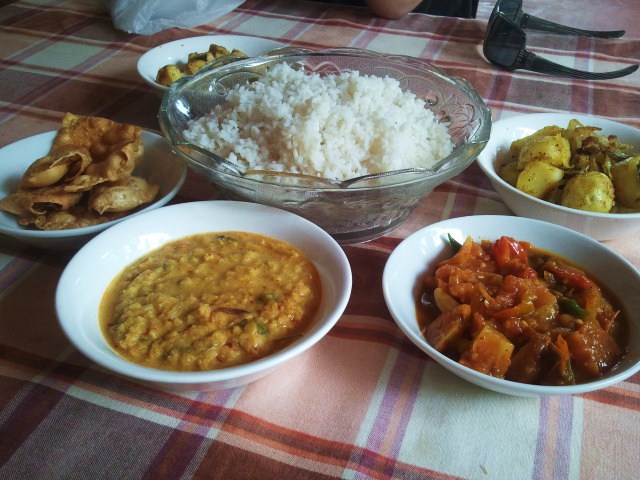
You won't be surprised to hear that Sri Lankan food is centrally curry and rice. Finding vegan food is very easy in Sri Lanka, as "Vegetable Curries and Rice" are on every menu and they are naturally dairy free - often using coconut milk and cream as their base. When you order vegetable curry and rice, you don't pick your curries, they just bring out a selection of vegetable curries, chutneys, sambals, papadums and rice.

Clockwise from top: dhal, chokoe curry, cabbage and kunlun, whole cooked garlic cloves, beetroot sambal, papadums

L-R: papadums, dhal, tomato curry, potato curry

Clockwise from top: okra curry, rice, chicken curry, tomato and cucumber salad, pumpkin curry, manioc curry

The above vegie curries on my plate.

Fried noodles with pineapple chutney and chilli paste

Unsurprisingly, Sri Lankans also eat curry for breakfast as well as lunch and dinner. Most of the guest houses we stayed in offered an option of ordering Western Breakfast (eggs, toast, jam, tea/coffee) or Sri Lankan Breakfast (curry, hoppers of some kind, curries, tea/coffee). I've always been a fan of eating savoury foods for breakfast, as I just don't really like many of the breakfasts typical of Western countries, so I actually loved the curry for breakfast - although we didn't manage to do it every day for three weeks! I admit we had to go for toast some mornings.

A Sri Lankan breakfast of rice & coconut milk squares, hot onion sambal and bananas.

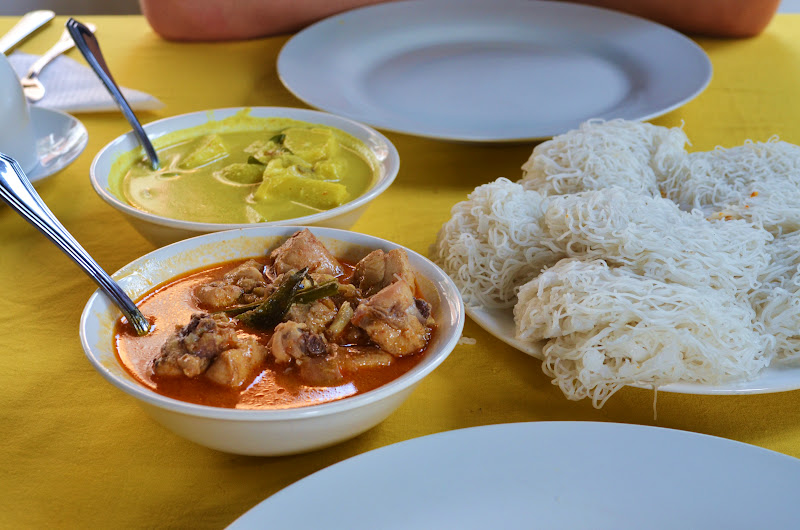
A Sri Lankan Breakfast of potato curry, chicken curry and string hoppers

A Sri Lankan breakfast of string hoppers, rotti, hoppers, coconut sambal and an egg hopper (with 2 curries in the background)

Egg curry and dhal

My friend's Western Breakfast - for those who don't feel like curry first thing in the morning!

A rare opportunity to get "moosly"


You could also buy King Coconuts on the side of the road anywhere in Sri Lanka, to drink and eat the small amount of soft flesh inside.


(not me)


The spoils of our amazing Sri Lankan cooking class in Unawatuna, for more details check out this post here!


Wednesday, 25 July 2012

Best Ever Vegan Carrot Cake


This have been very quiet on this blog lately - my apologies! I do, however, have an excellent excuse. I have spend the last three weeks in Sri Lanka having the most amazing holiday, thus not being able to post. If you keep your eye on the blog in the next few days you'll see lots of great pictures of all the curries I ate and a wonderful cooking class I took in Unawatuna (on Sri Lanka's south coast). First though, here is something very un-Sri Lankan!

I flew in last night and after a very long day of flying and today I slept until 12:40pm! Sounds bad, I know, but actually it was only 8am in Sri Lanka, so I didn't feel so bad! When I finally got myself out of bed I jumped back on my blog to see how it had fared in my absence. I was pleasantly surprised to see that the blog had quite a lot of hits still - thanks guys! I was also pleasantly surprised to find that I had about 3 hours left to enter the July Sweet Adventures Blog Hop - Nuts About Sweets.


Luckily I had this incredible vegan carrot cake in the archive, which is packed full of tasty walnuts! I'm a long time lover of carrot cake, but there are a lot of awful ones out there! I had it a lot as a kid but not as much as an adult. One night I had a real craving for carrot cake while I was out with friends so I decided to have a decidedly un-vegan moment (I'm only human! It happens sometimes) and bought a piece of carrot cake from a bakery on King St in Newtown. It was dreadful. Dry and bland cake covered in a thick icing which pretty much tasted like butter with a little bit of sugar. It was devastating and I threw most of it in the bin - all it did was make me crave real carrot cake more!!

So I knew I had to make a better one! It had to be my mother's recipe, so I decided to do a vegan version. It was incredible, the absolute best carrot cake I have ever eaten! So here it is - easy and delicious!

Ingredients

The Cake
1 cup oil
1 ½ cups sugar
1 teaspoon of cinnamon
1 teaspoon of salt (optional)
3 cups grated carrot
1 1/3 cups apple sauce
2 teaspoons baking soda
1 cup chopped walnuts or pecans
2 cups wholemeal flour

The Icing
1 tsp vanilla
60g nuttelex
125g vegan cream cheese
2 cups soft icing mixture

To Make
1. Mix sugar, oil and apple sauce well. 
2. Add dry ingredients (sifted), carrots and nuts. Mix well.
3. Pour into a greased and lined cake tin
4. Bake at 120 degrees celcius for 1 hour.
5. Remove and allow to cool for 20 minutes or so in the tin before turning out onto a cooling rack to cool completely.
6. Cream the vanilla, nuttelex and cream cheese together using an electric beater or a knife. Mix in the icing mixture and mix until completely smooth and fluffy. Ice the cake however you like.